
Quartz Ripple
How to Know If Your Business Idea Is Worth Pursuing (Before You Invest Any More Time)
You have spent a decade — maybe two — building expertise that most people don't have. You can see a gap in the market. You know exactly how to fill it. And somewhere between the clarity of that vision and the reality of building a business around it, things get complicated.
Most professionals who come to me with a business idea don't lack knowledge or capability. What they lack is a structured way to evaluate whether their idea is actually worth pursuing — before they sink months of time, credibility, and money into finding out the hard way.
I built Decision Gate because I've been on the wrong side of that equation myself. Here's what I've learned about how to know if a business idea is worth pursuing before you commit.
The Problem With Passion as a Business Plan
Experienced professionals are actually more vulnerable to this trap than first-time founders, not less.
When you've spent years developing deep expertise, you're not guessing about the value of what you know. You've seen it work. You've watched organisations pay significant sums to solve the exact problem you can solve. The confidence that comes from that track record isn't arrogance — it's earned.
But expertise and commercial viability are not the same thing. One tells you that your knowledge is real. The other tells you whether a specific group of people will pay for it in the specific form you're offering it, at a price that makes the business sustainable.
"I know this works" is evidence about the quality of your solution. It tells you almost nothing about whether you have a business.
The 5 Questions That Separate Viable Ideas From Expensive Experiments
Before committing any further resources to an idea, these five questions will do more useful work than any amount of enthusiasm or market research.
1. Is there a specific, reachable person who will pay for this?
Not a demographic. Not a type of person. A specific, nameable individual or organisation — someone you could write a name next to right now — who has both the problem and the budget to address it.
If your answer is "professionals in their 40s who want more autonomy," you don't have a buyer. You have a description. The difference matters enormously when it comes to actually converting an idea into revenue.
2. Does it solve a problem they're already spending money to fix?
This is one of the most reliable filters for commercial viability. If your target buyer is already paying someone — a consultant, a software subscription, a course, an employee — to address the problem you solve, you're entering an existing market. You're replacing something, not asking people to develop an entirely new behaviour.
Creating new buying behaviour from scratch is genuinely difficult, even with strong IP and a compelling offer. Competing for existing spend is a far more executable commercial position.
3. Can you deliver it without rebuilding your life around it?
This question matters specifically for professionals commercialising expertise rather than building venture-backed startups. The goal is sustainable independent income — not a second all-consuming career.
If your delivery model requires you to be available around the clock, take on unlimited clients, or build a large team before it becomes profitable, those are structural problems to solve before launch, not after. Operational viability is part of the evaluation, not an afterthought.
4. Is your expertise genuinely differentiated — or just experienced?
There's an important distinction here that many seasoned professionals miss. Depth of knowledge is not the same as commercial uniqueness. The question isn't whether you know a great deal about your field — you almost certainly do. The question is whether what you offer produces an outcome that your buyer cannot easily find somewhere else.
Differentiation shows up in your methodology, your results, your specific combination of disciplines, or your point of view. Experience alone doesn't create it. This is worth examining honestly before you build positioning around it.
5. What would have to be true for this to fail?
Most idea evaluation focuses on upside. This question focuses on the assumptions that, if wrong, would make the whole thing unworkable.
What has to be true about demand, pricing, delivery, competition, and your own capacity for this idea to succeed? Now ask: how confident are you that each of those things actually is true? This isn't pessimism — it's the kind of stress-testing that prevents expensive surprises.
Why Most Idea Evaluation Advice Fails Experienced Professionals
The standard "validate your idea" playbook — build an MVP, run ads to a landing page, see if anyone clicks — was designed for first-time founders with consumer products and no existing reputation to protect.
It doesn't map well to the situation of a senior professional commercialising deep IP. Your risks are different. The positioning damage from a poorly executed launch is real. The time cost of pivoting is higher. And crucially, your decision-making blind spots are different too.
Experienced professionals tend toward overconfidence about the idea and underconfidence about their ability to market it. They've seen the problem solved. They know the solution works. What they often underestimate is how much structural commercial work sits between a good solution and a viable business.
What's needed isn't a generic validation checklist. It's a structured decision architecture — one that evaluates the idea against the specific constraints, strengths, and goals of the professional pursuing it.
What a Decision Gate Actually Does
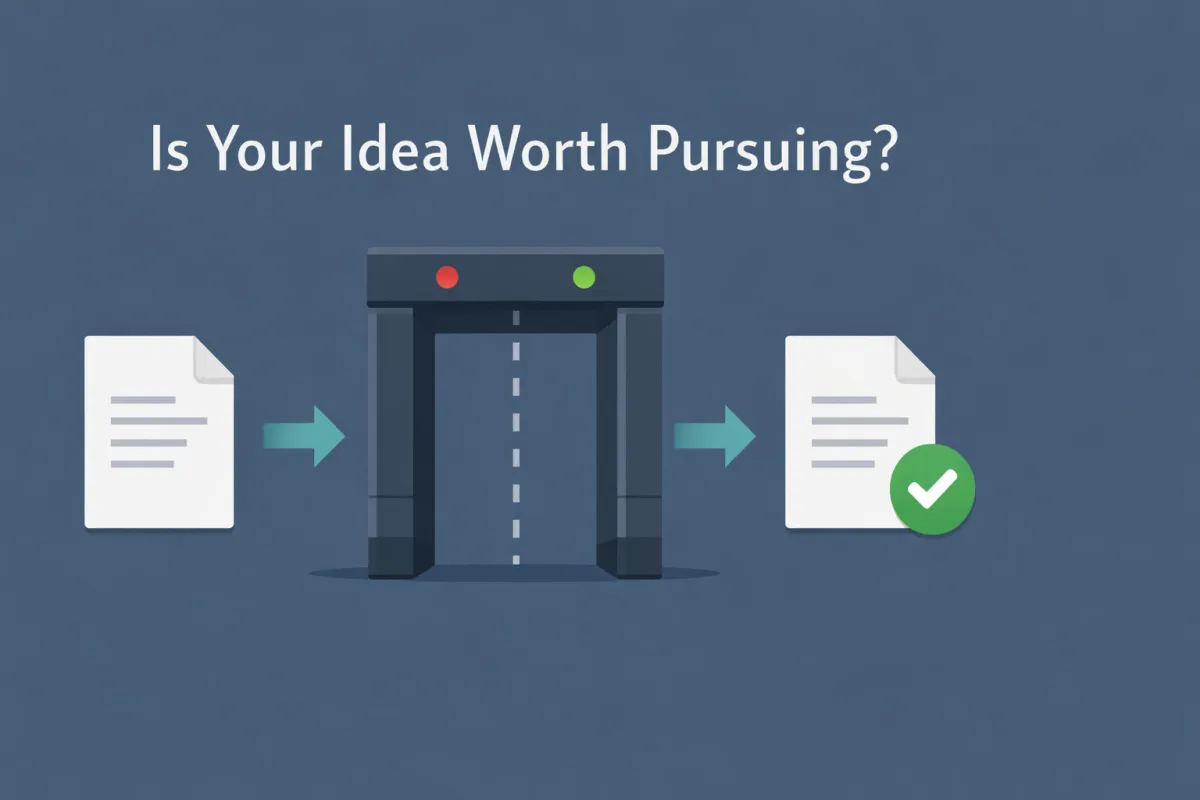
Decision Gate is a structured evaluation process designed specifically for experienced professionals making complex commercial decisions — including whether a business idea is worth pursuing.
It works by moving a decision through a set of defined evaluation criteria: commercial viability, strategic alignment, operational feasibility, and risk exposure. The output isn't a score or a spreadsheet. It's a reasoned go/no-go with the logic made explicit.
That matters because the value isn't just in the answer. It's in understanding why the answer is what it is — which blind spots were surfaced, which assumptions held, which ones didn't. That clarity is what allows you to act with confidence rather than hope.
Decision Gate is built for professionals who are ready to move. Not people still in the browsing phase, but practitioners who have something real and want to evaluate it with the rigour it deserves. If that's where you are, you can explore the process and apply at Quartz Ripple.
The Cost of Skipping This Step
The professionals who skip structured evaluation before launching aren't reckless people. They're optimistic ones. They've done the thinking, they believe in the idea, and they want to move.
What follows is usually a version of the same expensive lesson: months of effort building something that doesn't convert, positioned to the wrong buyer, priced incorrectly, or solving a problem the market isn't actively trying to fix.
The cost is measurable — in time, in money, in the erosion of credibility that comes from a public stumble. But the less visible cost is the opportunity lost. Every month spent course-correcting a poorly evaluated idea is a month not spent executing a well-evaluated one.
Most people can point to the exact moment they wish they'd had a gate.
How to Move From Idea to Evaluated Asset
The mindset shift that changes this is relatively simple, even if it isn't always easy: stop treating your IP as a passion project to be defended and start treating it as a commercial asset to be assessed.
That means being willing to ask hard questions before you've invested your identity in the answers. It means separating your expertise — which is real and valuable — from any particular commercial form of it, which may or may not be the right one.
If you're a professional with deep expertise and a business idea you're serious about, the most useful next action isn't more research or more refinement. It's a structured evaluation.
Apply for Decision Gate at Quartz Ripple and find out whether your idea has the architecture to become a business — or whether your time is better spent elsewhere.
MEET THE FOUNDER
Hi, I'm Catherine Gomersall!
I’m a Systems Architect designing structured commercial frameworks for experienced professionals who want to convert their expertise into sustainable income. With a background spanning digital media, academia and consulting, I’ve spent over a decade identifying the structural gap between high achievement and financial autonomy. My work focuses on building modular systems that transform knowledge into commercially viable assets, without requiring high-visibility personal branding or institutional dependency.
My Core Focus
• Designing modular revenue systems from existing expertise
• Structuring commercial assets with long-term sustainability in mind
• Translating complex knowledge into market-ready offers
• Reducing reliance on institutional gatekeeping
• Building intellectual and commercial autonomy through architecture, not hype
Graduate Certificate in Research Commercialisation
PhD in Communications
10+ years of results and experience in assisting professionals with Intellectual Property Commercialisation

As Featured in...
BRAINZ MAGAZINE
DIGITAL DEMYSTIFIED
COMPANY
RESOURCES
CUSTOMER CARE
NEWS
LEGAL
With our founder's office based on the bank of the Birrarung, we acknowledge that we live and work on Wurundjeri Country, and pay our respects to Elders past and present.

+61 416 802 808
© Copyright
Catherine Gomersall, Quartz Ripple 2026